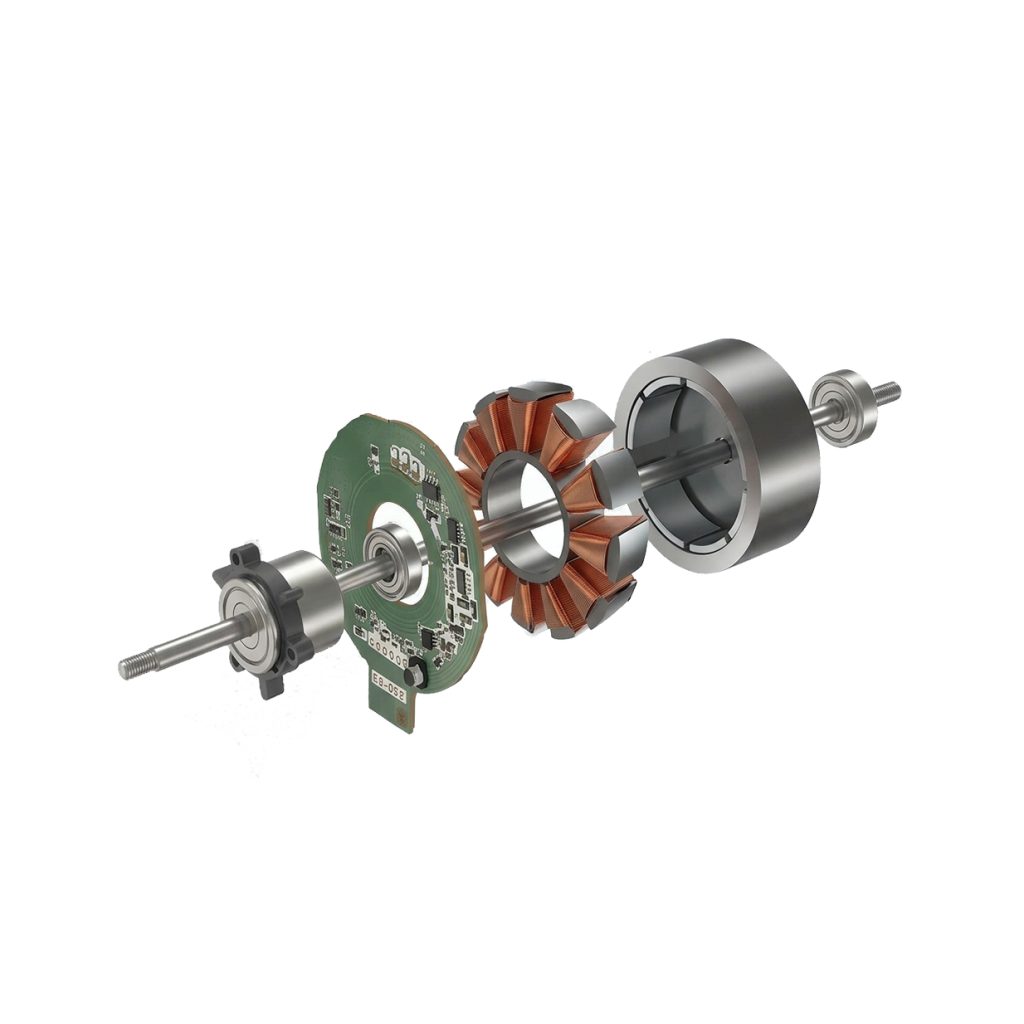
When choosing a fan for your home or office, you often focus on its appearance, size, or number of blades. However, the real “heart” of a fan is its motor.
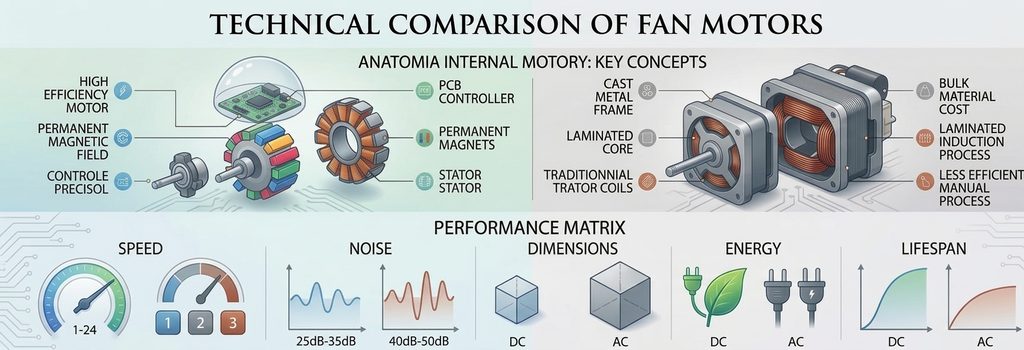
Today, there are two main types of motors on the market: Alternating Current (AC) motors and Direct Current (DC) motors. But what is the actual difference between these two technologies, and which one should you choose?
1. Energy efficiency and consumption: the DC motor wins
One of the most obvious advantages of DC motors (often referred to as BLDC – Brushless DC) is their energy efficiency.
- Energy consumption: At maximum speed, a DC fan consumes approximately 23W–24.1W, while an equivalent AC model requires approximately 45W–47.7W.
- Savings: BLDC motors use up to 65% less energy than traditional AC motors.
- Environmental impact: Using a DC fan can save approximately 30 kWh per year compared with an AC fan, significantly reducing its carbon footprint and electricity costs.
2. Quiet operation: acoustic comfort for your bedroom
If you are looking for a fan to use at night, noise is a crucial factor.
- DC fans: Thanks to the absence of mechanical friction in brushless motors and the use of ball bearings, these motors are ultra-quiet. At the lowest speed, they can achieve a very low sound level of just 30–32 dB(A) (almost equivalent to the sound of human breathing).
- AC fans: They often use sliding bearings, which produce a minimum noise level at low speed of around 46 dB(A).
3. Speed adjustment and control
The flexibility of use varies considerably between the two types:
- DC motors: They allow much more precise adjustment and a wide speed range. They generally offer 12 speeds (although some models provide between 8 and 24 different levels). They also maintain a very stable rotational speed at the selected setting.
- AC motors: They generally offer 3 preset speeds. The rotational speed tends to fluctuate slightly during operation.
4. Motor durability and longevity
Thanks to their different internal structure and the materials used:
- DC motor lifespan: Tested for continuous operation for more than 15,000 hours under rated conditions.
- AC motor lifespan: Generally rated for approximately 5,280 hours of continuous operation.
The DC motor therefore offers an operating life that is almost three times longer than that of a traditional AC motor.
5. Size and voltage versatility
- Design and weight: DC motors are more compact and lightweight, allowing designers to create fans with modern, slim and minimalist lines. AC motors are bulkier and heavier.
- Operating voltage: DC motors can operate stably across a wide voltage range (e.g. 80V–240V), making them more resistant to voltage fluctuations. AC motors, on the other hand, require a fixed nominal voltage (e.g. 220V).
Conclusion: Which one should you choose?
- Choose a DC fan if: You want maximum acoustic comfort (especially in the bedroom), want to save on electricity costs in the long term, and are looking for a durable, modern product with precise speed adjustment.
- Choose an AC fan if: You are looking for an immediately affordable, simple and intuitive solution for occasional use or for environments where background noise is not an issue.